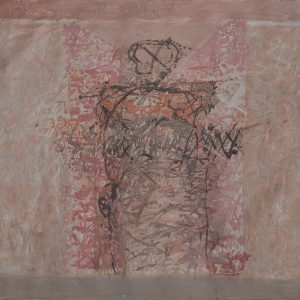
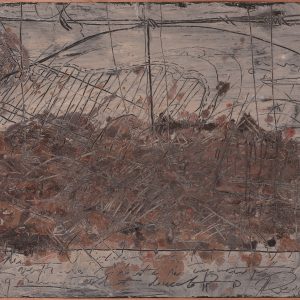
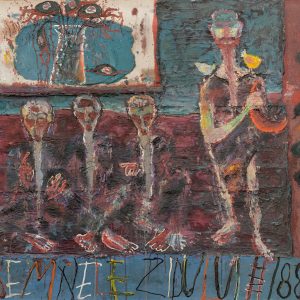
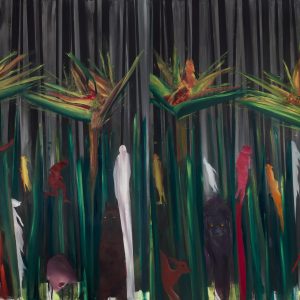
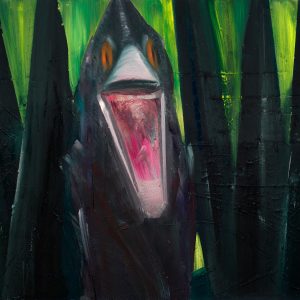
The first stage, which from a temporal point of view, corresponds to his debut and first exhibitions, covers the series “Masks” and “The Earth”. The early artworks approached painting from the physical angle of an expressivity defined by the force of “a somber action painting, loaded with a grave feeling of the painterly and worldly matter” (Magda Cârneci). The moment of unleashed fervor of the neo-expressionist phase is continued in the series “Signs on the Wall” and “Pictural Metaphors”. The painting of this first period was the expression of the realization of a consubstantiation with the primordial universe, of an identification of the vital energies of the cosmos with an ardent self, manifesting in color, the raw matter, and an utmost freedom of treating the figurative.
“Via Dolorosa” (presented at the São Paulo Biennial in 1991 and later, in 1996, at the Museum of Art from Cluj) marks the transition to a new form of expression of the self, hypostatizing the idea of sacrifice.
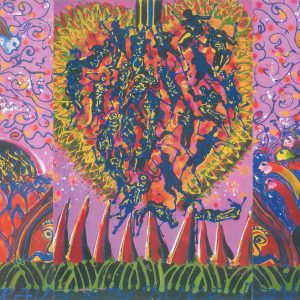
The next decade (1995-2005) is governed by the explosive freedom of the imagination, manifested in the series “The Wonderful Hours of Duke d’Ivry”, followed by “The Magical Travel of Duke d’Ivry” (Muzeul Țării Crișurilor from Oradea, 1997 and the Galleries of the National Theatre, floor ¾, Bucharest). Referring to this luxuriant stage, the same Magda Cârneci noted: “The curve is as skyrocketing as it is dazzling, because now Mureșan seems to have reached an upper level of the psyche, that of the unleashed, fairy-like, overflowing imaginary. It is as if – in a necessary dialectic for the evolution of the individual –, after the early beginnings still bounded to the opaque materiality of the world, after a descent into the psychical inferno, with its individual and collective malebolge, the painter’s spirit has reached the clear altitude of freedom.”
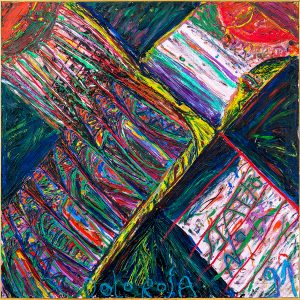
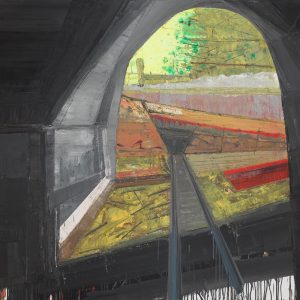
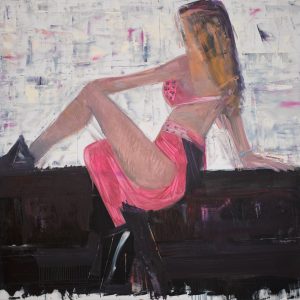
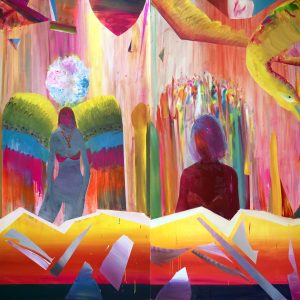
What follows is an almost ten-years hiatus, stretching to 2014, a time of crucial artistic and existential decantation. At first, the comeback brings a different register to the surface of creation, one more austere, in the form of the series “Ultransilvania” – exhibited for the time in 2021. Next, after the series of the “Secret Passages” (2015-2016) – the result of an existential revelation translated into painting, the artist will turn his attention to Eros, as magic universal energy, the vital principal of individualization, the discovery journey of the self towards the all-encompassing Self, in the series “Escorts” and “Erotikonia”. The Eros manifests itself in phantasmagorical projections converted into artistic images and painterly language that unearth oneiric and mnemonic traces, mytho-poetic rests, sediments of the subconscious (the exhibition “Erotikonia” opened at Muzeul Țării Crișurilor from Oradea in 2019).
The years 2020-2021 came with a new challenge. The series “Apud Magister” acts as the expression of maturity. Freed from any influences and mimicry, the artworks play the card of the practice of appropriation, as expression of the programmatically assumed dialogue with other cultural forms. The artists invited as interlocutors to this critical dialogue are Titian, Giorgione, Jean-Honoré Fragonard, Marcel Duchamp, to briefly name just a few. “Variations from the Quinto del Sordo” completes the dialogue initiated with the masters, with a more pronounced freedom of expression; the connection with Goya, that from the “black paintings”, remaining only allusive, on the level of the title.